|


GNU Unifont is a Unicode-based dual-width monochrome font, with glyphs in a grid of 8 or 16 pixels wide by 16 pixels tall. Currently, the main format is OpenType, which provides scalable glyphs (see an OpenType sample at left). The original intent of Unifont was to offer a simple font format with wide Unicode coverage to render something meaningful for each Unicode code point, rather than a blank box (“tofu”) for missing glyphs. This simple format has allowed many, many volunteers to contribute thousands of glyphs.
GNU Unifont is part of the GNU Project.
This page contains the latest release of GNU Unifont, with glyphs for every printable code point in the Unicode Basic Multilingual Plane (BMP). The BMP occupies the first 65,536 code points of the Unicode space, denoted as U+0000..U+FFFF. There is also growing coverage of the Supplementary Multilingual Plane (SMP), in the range U+010000..U+01FFFF, of Michael Everson's ConScript Unicode Registry (CSUR) with Rebecca Bettencourt's Under-CSUR (UCSUR) additions, and of Plane 2 and Plane 3 CJK ideographs.
Because of the fixed 16-bit limit of 216 = 65,536 glyphs per OpenType or TrueType font, Unifont requires more than one font file to include all of its glyphs in those formats. As a result, the basic Unifont font file contains Unicode Plane 0 glyphs (one glyph per visible Unicode code point), and upper Unicode planes are contained in the "Upper" font file series. The exception is that the "JP" (Japanese variant) OpenType and TrueType fonts provide coverage of all of Unicode Plane 0 (using Japanese variants of CJK ideographs) plus the upper Unicode plane glyphs necessary to provide complete JIS X 0213 coverage, for a total of about 59,000 glyphs.
BDF and PCF font formats only support Unicode Plane 0 code points, as a limitation of the X Window System handling of those font formats.
Use with Non-Free Software
A user has asked if GNU Unifont can be used with non-free software. The answer is yes. The GNU Font Embedding Exception and the SIL OFL allow for that. See the next section for details. The main purpose of the licensing is to require derivative fonts that others create to be released to the public under the same licensing terms, not to prohibit the use of those fonts with certain software. Thus, preserving the license terms in derivative fonts provides a public benefit. The licenses also provide acknowledgement of previous Unifont contributors for their volunteer work.
Copyright, Derivative Works, and License
Thousands of Unifont glyphs are creations of individual Unifont contributors; those glyphs enjoy copyright protections of various degrees. Some of those contributions are letter forms of established alphabets while others are icon (symbol) designs such as the many animal icons which, as artistic designs, have even stronger international protections. See for example this memorandum of applicable laws of Berne Union member country Germany (where Unifont was created): Unifont Copyright Protections.
Derivative variants of Unifont are permitted under the terms of the dual license: GNU GPLv2+ with the GNU Font Embedding Exception and the SIL Open Font License version 1.1. These are free licenses. The remainder of this section provides details.
These font files are licensed under the GNU General Public License, either Version 2 or (at your option) a later version, with the exception that embedding the font in a document does not in itself constitute a violation of the GNU GPL. The full terms of the license are in LICENSE.txt.
As of Unifont version 13.0.04, the fonts are dual-licensed under the SIL Open Font License (OFL) version 1.1 and the GNU GPL 2+ with the GNU font embedding exception. The SIL OFL is available at OFL-1.1.txt.
Font Downloads
The standard font build — with and without the ConScript Unicode Registry (CSUR) / Under-CSUR Private Use Area (PUA) glyphs. Download in your favorite format:
-
OpenType:
- The Standard Unifont OpenType Download: unifont-18.0.01.otf (5 Mbytes)
- Japanese OpenType Version: unifont_jp-18.0.01.otf (5 Mbytes)
- Unicode T-source Chinese OpenType Version: unifont_t-18.0.01.otf (5 Mbytes)
- Glyphs above the Unicode Basic Multilingual Plane: unifont_upper-18.0.01.otf (1 Mbyte)
- Unicode ConScript Unicode Registry (CSUR) PUA Glyphs: unifont_csur-18.0.01.otf (0.5 Mbyte)
-
PCF:
- unifont-18.0.01.pcf.gz (1 Mbyte)
- Japanese PCF Version: unifont_jp-18.0.01.pcf.gz (1 Mbyte)
- Unicode T-source Chinese PCF Version: unifont_t-18.0.01.pcf.gz (1 Mbyte)
-
BDF:
- unifont-18.0.01.bdf.gz (1 Mbyte)
- Japanese BDF Version: unifont_jp-18.0.01.bdf.gz (1 Mbyte)
- Unicode T-source Chinese BDF Version: unifont_t-18.0.01.bdf.gz (1 Mbyte)
Specialized versions — built by request:
- PSF: A specialized PSF 1 console frame buffer font consisting of 512 glyphs for use with APL, A Programming Language, in console mode (single-user mode on GNU/Linux, etc.), mainly to support GNU APL: Unifont-APL8x16-18.0.01.psf.gz (4 kbytes)
- HEX: All the Plane 0 glyphs in Roman's .hex format, for those who wish to experiment: unifont-18.0.01.hex.gz (1 Mbyte)
- HEX: The above .hex file with combining circles added: unifont_sample-18.0.01.hex.gz (1 Mbyte)
On Windows or macOS, unzip the .ttf.zip file or download the uncompressed .ttf file and copy the font to your Fonts folder. On Microsoft Windows, this folder is located under the Windows folder on your main disk. On a Mac, this is located under the Library folder on your main disk.
Alternatively on macOS, the suite of OpenType fonts can be installed using a Homebrew cask with the terminal window command
brew install font-gnu-unifont
and updated to a new version with
brew upgrade font-gnu-unifont
See https://brew.sh/ for more on Homebrew for macOS.
For best appearance on a Mac in a Terminal window, select Terminal from the menu, then Preferences. A Settings window will appear. Make sure that you're on the Text tab in that window. Then make sure that the "Antialias text" box is checked. The OpenType version of the font should then look fine at point sizes of 12pt and larger. The font won't look very legible in a Mac Terminal window unless you select this antialias option.
Note: BDF, PCF, and OpenType files contain dimension and spacing information for each glyph in a font. Some font rendering engines ignore this glyph information that the font file provides. This is especially true of rendering engines designed to handle monospace fonts. Unifont will not display all glyphs correctly with such software. The BDF font follows BDF version 2.1 (not version 2.2) because the the X Window System standardized on version 2.1. The PSF 1 version of Unifont is a monospace font but is limited to 512 glyphs, and is only of use with font rendering engines that support more than 256 glyphs in a console frame buffer font.
All unifont.hex sources are in the full Unifont Utilities download page.
Unifont Limitations
Unifont only stores one glyph per printable Unicode code point. This means that complex scripts with special forms for letter combinations including consonant combinations and floating vowel marks such as with Indic scripts (Devanagari, Bengali, Tamil, etc.) or letters that change shape depending upon their position in a word (Indic and Arabic scripts) will not render well in Unifont. In those cases, Unifont is only suitable as a font of last resort. Users wishing to properly render such complex scripts should use full OpenType fonts that faithfully display such alternate forms.
Drawing New Glyphs
If you would like to contribute glyphs, please email unifoundry at gmail in advance (not spelled out because of spammers). Several contributors are working on new glyphs, and it would be unfortunate to have multiple persons drawing the same glyphs.
Special Note: New Plane 2 and Plane 3 CJK Glyphs
The People's Republic of China (PRC) has a set of 15-by-16 pixel Chinese glyphs for Unicode Plane 2 and Plane 3. However, those glyphs are copyrighted and licensed for sale by the Government of the PRC, and thus they cannot be used in a free font. If you happen to have any of those copyrighted 15-by-16 pixel glyphs, please do not send them for inclusion. Unifont includes many glyphs in this range, drawn by Chinese and Japanese volunteers. More are planned for the future.
Release Notes
This latest release is part of the GNU Project. You can view the GNU Project Unifont Page on Savannah.
The theoretical maximum number of printable glyphs in the Unicode Plane 0 range is 65,536 code points minus the 2,048 surrogate pair code points, minus the 6,400 Private Use Area code points, minus the two noncharacters (U+FFFE and U+FFFF). This amounts to 57,086 assignable code points apart from the Private Use Area.
The theoretical maximum number of printable glyphs in the higher Unicode planes is 65,534; the last two code points in each plane are reserved as noncharacters.
Unifont 18.0
-
16 September 2026 (Unifont 18.0.01)
-
Plane 0
-
David Corbett:
- Updated Arabic glyph U+06C4 per the Unicode 18.0.0 change.
- Modified Latin glyphs U+0271, U+027F, U+0285, U+02A9, U+02AE, U+1D4F, U+1D83, U+1DB0, U+1DB2, U+1DB7, and U+1DB8 to better match updates in the Latin Extended-G range.
- Drew the Omani Riyal currency symbol (U+20C4).
- Further modified glyphs U+02C8, U+05C8, U+208F, U+20C2, U+20C3, U+AB4B, U+AB4C, U+AB6C, and U+AB6D.
- Paul Hardy added the other new Plane 0 glyphs.
-
David Corbett:
-
Plane 1
- evie undis contributed the new Latin Extended-G glyphs (U+1DF00..U+1DFFF).
-
Paul Hardy:
- Drew the new glyphs in Latin Extended-F, Devanagari Extended-A, Bengali Supplement (U+11DF0..U+11DFF),* Musical Symbols, Musical Symbols Supplement (U+1D250..U+1D28F),* Mathematical Alphanumeric Symbols, Enclosed Alphanumeric Supplement, Transport and Map Symbols, Geometric Shapes Extended, and Symbols and Pictographs Extended-A.
- Updated Alchemical Symbols U+1F730, U+1F73C, and U+1F76D per the Unicode 18.0.0 change.
-
David Corbett:
- Added the new glyphs in Arabic Extended-C (U+10EC0..U+10EFF).
- Further updated Latin Extended-G glyphs (U+1DF00..U+1DFFF).
- Updated Miscellaneous Symbols Supplement (U+1CEC0..U+1CEFF).
- Added glyphs in Miscellaneous Symbols and Arrows Extended (U+1DB00..U+1DBFF).*
- Further modified U+1D13A, U+1D13B, U+1D13C, U+1D1F7, and U+1D1FF.
-
Johnnie Weaver added the new glyphs in:
- Khitan Small Script (U+18B00..U+18CFF)
- Kana Extended-A (U+1B100..U+1B12F)
- Small Kana Extension (U+1B130..U+1B16F).
-
Plane 2
- Lakejason0 (湖 远星) has drawn the new CJK Unified Ideographs Extension D ideograph, U+2B81E.
-
Plane 0
Unifont 17.0
-
28 June 2026 (Unifont 17.0.05)
-
Plane 0
- Paul Hardy modified U+0E1A and U+0E1B to prevent their being mistaken for other Thai letters. Thanks to Rachpol Kraithong for reporting this.
- Lucas2763 redrew Syriac Supplement glyphs U+0860..U+0865 and U+0867..U+086A.
- David Corbett redrew Syriac Supplement glyph U+0866.
- 幻鹫_Blezig redrew U+3D07 to add a missing pixel and to avoid a collision with the third 水 (water) component.
- Kusanagi_Sans adjusted U+56B9, U+74D2, U+9FA7, and U+9FAA so the rightmost column would be empty, conforming to the rest of the Chinese glyphs.
- Yzy32767 has improved the Bopomofo Extension glyphs (U+31A0..U+31BF) to match the style of the previous change to Bopomofo basic block.
- Kusanagi_Sans modified U+9FA9 to make the right column empty.
-
Plane 1
- Hayden Wong has drawn Tangut Components glyphs U+18800..U+188FF.
-
Plane 2
- Paul Hardy added a missing pixel in U+2072A and removed U+24295, which was the glyph for U+24259. Thanks to Lucas2763 for noticing these errors.
- 幻鹫_Blezig drew the following 596 glyphs U+23D13, U+2633D, U+26C29, and U+2795B..U+27BAA.
- 幻鹫_Blezig also added the 172 missing glyphs U+27900..U+2790E, U+27910..U+27916, U+27918..U+27943, U+27945..U+2795A, U+27BAB..U+27BC5, and U+27BC7..U+27BFF.
- Lucas2763 has added these missing glyphs: U+20804..U+20806, U+20808, and U+20809..U+20837.
- Lakejason0 (湖 远星) adjusted U+201A2 to make the right column empty.
- Kusanagi_Sans modified U+2012F, U+20176, U+201EB, U+2020A, U+20223, U+20228, U+202ED, U+24AC9, U+25562, U+2648D, and U+29BDD to make the right column empty.
-
Plane 3
- Kusanagi_Sans modified U+323F7 to make the right column empty.
-
Plane 0
-
13 March 2026 (Unifont 17.0.04)
-
Plane 0
- Kusanagi_Sans and Kao Chen-tung (高振東) added a new set of over 28,000 Unicode Standard T-source Chinese glyphs that parallel the Wen Quan Yi Unicode G-source Chinese glyphs. This new collection of glyphs is available as unifont_t BDF, PCF, and OpenType font files.
- Paul Hardy adjusted several Devanagari glyphs (U+0900..U+097F).
- 晓晓Akatsuki adjusted several Chinese glyphs: U+3749 (㝉), U+99CD (駍), U+99FB (駻), U+99FD (駽), U+3D6E (㵮), and U+6A5C (橜).
-
Plane 1
- Johnnie Weaver modified several Ancient Symbols glyphs: U+10194, U+10196, U+10197, U+10198, U+10199, and U+1019C.
-
Plane 2
-
晓晓Akatsuki
- Adjusted several Chinese glyphs: 𠐭, 𬭛, and 𥝱.
- Completed all variant characters (except for one unencoded character) not in BMP, listed in Appendix 1 of the 通用规范汉字表 (List of Commonly Used Standard Chinese Characters).
- Updated U+2CD88 (𬶈) and U+2CD8B (𬶋) after yzdnn reported that the glyph for U+2CD88 (𬶈) was mistakenly made identical to that of U+2CD8B (𬶋).
- Completed the first 2100 characters of the 古籍印刷通用字规范字 形表 (Standardized Character Form Table for Commonly Used Characters in Ancient Book Printing) by adding: 𠤰, 𠪱, 𠯘, 𠱛, 𠴟, 𠴰, 𠷺, 𠻳, 𡍪, 𡐨, 𡒃, 𡚁, 𡨥, 𡬶, 𡵙, 𡶄, 𡻯, 𢇷, 𢔄, 𢘍, 𢛁, 𢠵, 𢠸, 𢪘, 𢬸, 𢮥, 𢷬, 𣋞, 𣎗, 𣖾, 𣘻, 𣙜, 𣜬, 𣪁, 𣰨, 𣺌, 𤊹, 𤊿, 𤋮, 𤏶, 𤐣, 𤜻, 𤠢, 𤡳, 𤥭, 𤨏, 𤰜, 𤱈, 𤱊, 𤸪, 𤺥, 𤺺, 𥝧, 𥝱, 𥤚, 𥦗, 𥨎, 𥰭, 𥲻, 𥳠, 𥻅, 𥿊, 𦂌, 𦂳, 𦃂, 𦉆, 𦉹, 𦊱, 𦍑, 𦐊, 𦕈, 𦘴, 𦞂, 𦩘, 𦪭, 𦱔, 𦵏, 𦺇, 𧋥, 𧌽, 𧐱, 𧓽, 𧝎, 𧝬, 𧱓, 𧴃, 𧴐, 𧸘, 𧿒, 𨁝, 𨄌, 𨋰, 𨚓, 𨚲, 𨺭, 𨽍, 𨽻, 𩅦, 𩍿, 𩓐, 𩗗, 𩡩, 𩣡, 𩥄, 𩨸, 𩪋, 𪆻, 𪇘, 𪇰, 𪎽, 𪒠, 𪓐, and 𭁵.
- Added 𠯥, 𡦼, 𡵉, 𢖳, 𢩪, 𢬂, 𣎶, 𣲪, 𣵚, 𤆂, 𤝌, 𤴥, 𥘉, 𥘎, 𥘑, 𥘯, 𥘵, 𥙊, 𥙿, 𦫸, 𧉾, 𨒂, 𩩲, 𪫆, 𫀆, 𫇲, 𫍝, 𫠣, 𫤭, 𫧇, 𫶬, 𫹵, 𬁟, 𬂭, 𬒳, 𬒽, 𬒾, 𬡂, 𭙕, 𭴈, 𭷔, 𭻾, 𮇘, 𮮑, and 𰠨.
-
Koolhaas:
- Contributed these glyphs: 𩩰, 𩩱, 𩩳, 𩩴, 𩩵, 𩩶, 𩩷, 𩩸, 𩩹, 𩩺, 𩩻, 𩩼, 𩩽, 𩩾 𩩿, 𩪠, 𩪡, 𩪢, 𩪣, 𩪤, 𩪥, 𩪦, 𩪧, 𩪨, 𩪰, 𩪱, 𩪲, 𩪳 𩪴, 𩪵, 𩪶, 𩪷, 𩪸, 𩪹, 𩪺, 𩪻, 𩪼, 𩪽, 𩪾, 𩪿, 𩫀, 𩫁 𩫂, 𩫃, 𩫄, 𩫅, 𩫆, 𩫇, 𩫈, 𩫉, 𩫊, 𩫋, 𩫌, 𩫍, 𩫎, 𩫏 𩫐, 𩫑, 𩫒, 𩫓, 𩫔, 𩫕, 𩫖, 𩫗, 𩫘, 𩫙, 𩫚, 𩫛, 𩫜, 𩫝 𩫞, 𩫟, 𩫠, 𩫡, 𩫢, 𩫣, 𩫤, 𩫥, 𩫦, 𩫧, 𩫨, 𩫩, 𩫪, 𩫫 𩫬, 𩫭, 𩫮, 𩫯, 𩫰, 𩫱, 𩫲, 𩫳, 𩫴, 𩫵, 𩫶, 𩫷, 𩫸, 𩫹 𩫺, 𩫻, 𩫼, 𩫽, 𩫾, and 𩫿.
- Modified these glyphs to more closely match the style of other Chinese glyphs: 𠀅, 𠘦, 𠚳, 𠚴, 𠚵, 𠚻, 𠛴, 𠜟, 𠜠, 𠝋, 𠝙, 𠝫, 𠝰, and 𠟲.
-
晓晓Akatsuki
-
Plane 3
- 晓晓Akatsuki added 𰹷, 𰽙, 𱺑, , , , , and .
- Koolhaas added 𱟛.
-
Plane 0
-
1 November 2025 (Unifont 17.0.03)
-
晓晓Akatsuki, Boris Zhang, Kusanagi_Sans, and
others updated over 100 Chinese ideographs in Planes 0, 2, and 3:
- Modified ideographs containing the "馬" (Horse) and "鳥" (Bird) radicals to be more balanced
- The first batch of simplified Chinese character lists (第一批簡體字表) (August 21, 1935~February 1936)
- Chinese Character Simplification Scheme (1956–1986)
- The simplified character list (1986–2013), including simplified radicals and Chinese characters used for descriptions and annotations in official documents
- The second list of the Second round of simplified Chinese characters (not officially implemented)
- Ideographs required by the Specification of Common Modern Chinese Character Components and Components Names (现代常用字部件及部件名称规范), published in mainland China in 2009
- Other changes; see the ChangeLog file in the main package for details.
-
晓晓Akatsuki, Boris Zhang, Kusanagi_Sans, and
others updated over 100 Chinese ideographs in Planes 0, 2, and 3:
-
18 October 2025 (Unifont 17.0.02)
-
Plane 0:
- Paul Hardy modififed U+1521, U+A93D, and U+FB30.
- David Corbett modified U+2B96, U+!7CE, U+A7CF, and U+A7D2
- 晓晓Akatsuki adjusted U+4748, U+6B25, and U+6F78 per the latest Unicode recommendations. Adjusted U+5100 to be 16 pixels tall.
-
Plane 1:
- Paul Hardy modififed U+1E912 per Unicode 17.0.0 errata.
- David Corbett modified U+1CEDD, U+1E6DE, U+1F778, U+1CEF0, U+1F77A, U+11DCC, U+11DCD, U+11DD6. Adjusted base height in chess glyphs U+1FA54..U+1FA57 and eye height in U+1FA55 and U+1FA57 to match eye height of knights.
- 晓晓Akatsuki drew smaller versions of U+16FF2 and U+16FF3.
-
Plane 2:
- For complete coverage of jf7000 0.9, Boris Zhang added U+217DA and U+21A4B; 湖 远星 added U+24259, U+249DF, and U+270FD.
- 晓晓Akatsuki redrew U+29B9A.
-
Plane 3:
- 晓晓Akatsuki drew U+323B0..U+32401, U+32403..U+32406, U+32409..U+32452, U+32454..U+3246A, U+3246C..U+3247D, U+3247F..U+32484, U+32486..U+3248D, and U+3248F..U+324A4.
- Boris Zhang redrew U+2B7A4, U+2B7E8, and U+2EC06.
- Boris Zhang drew U+32402, U+32407, U+32408, U+32453, U+3246B, U+3247E, U+32485, U+3248E, U+324D1, U+324DD, U+324DE, U+324E0, U+3251F, U+32520, U+3261E, U+32623, U+32629, U+3262C, U+32631, U+32632, U+32635, U+3263B, U+3263C, U+3263F, U+32640, U+32641, U+32644, U+32646, U+32647, U+3264F, U+32650, U+32656, U+32657, U+3265A, U+3265D, U+3265E, U+3265F, U+32660, U+32662, U+32669, U+3266F, U+32672, U+32674, U+3267B, U+3267C, U+3267D, U+32688, U+3268A, U+3268F, U+32694, U+32695, U+3269A, U+326AD, U+326BD, U+326BE, U+326C0, U+326F5, U+326FA, U+32709, U+3270B, U+32714, U+32744, U+32748, U+3274B, U+3274C, U+3274E, U+32755, U+32765, U+32768, U+32769, U+327C0, U+327C3, U+327FB, U+32800, U+32859, U+3285A, U+3285F, U+3287C, U+32901, U+32940, U+3295B, U+32985, U+32996, U+32997, U+32A3A, U+32A3B, U+32A4C, U+32A5A, U+32A72, U+32A98, U+32ACE, U+32AF9, U+32BDD, U+32BE1, U+32BE8, U+32BFF, U+32C0A, U+32C0D, U+32C0E, U+32C13, U+32C36, U+32C37, U+32C39, U+32C3B, U+32C3C, U+32C82, U+32CCA, U+32CCC, U+32CCD, U+32CD3, U+32CD4, U+32CD6, U+32CDA, U+32CDC, U+32CDD, U+32CE4, U+32CE5, U+32CE6, U+32CF3, U+32CF4, U+32CF7, U+32CFD, U+32D09, U+32D46, U+32D49, U+32D4F, U+32D50, U+32D79, U+32D89, U+32DAF, U+32DB7, U+32E2F, U+32E31, U+32E34, U+32E8B, U+32EA3, U+32ED0, U+32EF0, U+32EF2, U+32F17, U+32F1D, U+32F1E, U+32F36, U+32F49, U+32F56, U+32F58, U+32F59, U+32F6C, U+32F8C, U+32F9D, U+32FF9, U+3301A, U+33074, U+33084, U+330AC, U+330D4, U+330F1, U+330F2, U+33113, U+33157, U+331B2, U+331E7, U+331E9, U+331EA, U+331EF, U+331F0, U+331F2, U+33211, U+33213, U+33214, U+33215, U+33216, U+33217, U+3321B, U+33220, U+3323A, U+33255, U+33257, U+33261, U+33279, U+3327A, U+3327C, U+33282, U+33283, U+33287, U+3328B, U+3328E, U+3328F, U+33291, U+33293, U+33294, U+332AD, U+332BF, U+332E1, U+3331A, U+3331E, U+33366, U+33397, U+33398, U+3339A, U+3339D, U+33400, U+3340A, and U+33410.
-
Plane 0:
-
9 September 2025 (Unifont 17.0.01)
-
Plane 0:
- David Corbett contributed the new Arabic glyphs:
- Arabic Extended-B: U+088F
- Riyal currency symbol: U+20C1
- Arabic Presentation Forms-A: U+FBC3..U+FBD2, U+FD90, U+FD91, and U+FDC8..U+FDCE.
- Paul Hardy added:
- Telugu: U+0C5C
- Kannada: U+0CDC
- Combining Diacritical Marks Extended: U+1ACF..U+1ADD, and U+1AE0..U+1AEB
- Updated U+1BBF
- Miscellaneous Symbols and Arrows: U+2B96
- Latin Extended-D: U+A7CE, U+A7CF, U+A7D2, U+A7D4, and U+A7F1
- Latin Extended-E: modified U+AB4B and U+AB4C per Unicode 17.0.0 recommendation.
- David Corbett contributed the new Arabic glyphs:
-
Plane 1:
- David Corbett contributed the new Arabic Extended-C glyphs: U+10EC5..U+10EC7, U+10ED0..U+10ED8, U+10EFA, and U+10EFB.
- Johnnie Weaver contributed:
- U+10940..U+1095F (Sidetic)*
- U+11DB0..U+11DEF (Tolong Siki)*
- U+16EA0..U+16EDF (Beria Erfe)*
- U+1E900..U+1E95F (Adlam), modified per Unicode 17.0.0 changes.
- Paul Hardy contributed:
- U+11B60..U+11B67 (Sharada Supplement)*
- U+16FF2..U+16FF6 (Ideographic Symbols and Punctuation)
- U+1CCFA..U+1CCFC and U+1CEBA..U+1CEBF (Symbols for Legacy Computing Supplement).
- U+1CEC0..U+1DEFF (Miscellaneous Symbols Supplement)*
- U+1E6C0..U+1E6FF (Tai Yo)*
- U+1F6D8 (Transport and Map Symbols)
- U+1F8D0..U+1F8D8 (Supplemental Arrows-C)
- U+1FBFA (Symbols for Legacy Computing).
-
Plane 2:
- Yzy32767 made these contributions:
- Improved these glyphs in the first list of the second round of simplified Chinese characters: U+0200D3 and U+0201A8
- Added these glyphs in the first list of the second round of simplified Chinese characters: U+20B15, U+20BB5, U+20CAD, U+219F3, U+21C52, U+22342, U+22488, U+22A83, U+2418A, U+2462F, U+26678, U+26B01, U+2A9F7, U+2BA4F, U+2BA51, U+2BBDC, U+2BCB7, U+2BDC0, U+2BE6F, U+2D026, U+2D64F, U+2D70C, U+2DCFF, and U+2E0B9
- Fixed U+2CAD2, which wfz2020 noticed appeared as the glyph for code point U+2CA02.
- Yzy32767 made these contributions:
-
Plane 3:
- Yzy32767 made these contributions:
- Improved these glyphs in the first list of the second round of simplified Chinese characters: U+030008, U+030061, U+03006C, U+03011D, U+03014A, and U+0301E3
- Added these glyphs: U+30180..U+301E2, U+301E4..U+301FF, U+30270, U+302D9, U+302DB, U+302DC, U+302DE, U+302F7, U+302FB, U+30335, U+3033B, U+3034E, U+30370, U+30371, U+30409, U+30414, U+3043A, U+3043F, U+3044A, U+3044C, U+30450, U+3045D, U+3045E, U+304CC, U+304E2, U+304E3, U+304E8, U+304ED, U+3057A, U+305D1, U+305DD, U+305F6, U+3067D, U+306D1, U+306D3, U+306EC, U+30708, U+30776, U+30831, U+30842, U+308F2, U+3094C, U+30955, U+30969, U+30993, U+309AA, U+309AB, U+30A1B, U+30A62, U+30AA9, U+30AB1, U+30AFE, U+30B04, U+30B0A, U+30B15, U+30B43, U+30B4B, U+30B5D, U+30BF6, U+30C21, U+30C2B, U+30CBD, U+30CC7, U+30D4B, U+30D55, U+30D5F, U+30DDF, U+30DE3, U+30E01, U+30E04, U+30E70, U+30E79, U+30F03, U+30F5F, U+30F64, U+30F82, U+310AA, U+3114C, and U+31151.
- Yzy32767 made these contributions:
-
Plane 0:
Unifont 16.0
-
31 May 2025 (Unifont 16.0.04)
-
Plane 0:
- Paul Hardy
- Modified the archaic Greek digamma glyphs, U+03DC and U+03DD.
- Modified the Korean Won currency symbol, U+20A9, to only have one bar.
- Removed Variation Selector glyphs (U+FE00..U+FE0F) from default OpenType and TrueType font builds; they remain in the sample and SBIT font builds.
- David Corbett
- Modified Arabic glyphs U+0610, U+0616, U+061E, U+0620, and U+0626.
- Redrew the yeh-based glyphs in the ranges U+FC31..U+FDC7 (Arabic Presentation Forms-A) and U+FE89..U+FE8C (Arabic Presentation Forms-B).
- Johnnie Weaver modified some Georgian Supplement glyphs (U+2D00..U+2D2F).
- 晓晓_Akatsuki (Xiao_Akatsuki) modified U+2EB2 per Unicode updates.
- Paul Hardy
-
Plane 1:
- Paul Hardy
- Updated Old Turkic glyph U+10C47.
- Updated Khitan Small Script glyph U+18CCA.
- Reverted several changes in Musical Symbols (U+1D100..U+1D1FF) for better positioning with combining characters. Thanks go out to David Corbett for requesting the changes.
- Modified mathematical bold digamma (U+1D7CA, U+1D7CB) to match the updated digamma glyphs in Plane 0.
- Josh Hufford contributed modified emoji glyphs U+1F602, U+1F605, U+1F606, U+1F607, U+1F609, U+1F923, and U+1FAE0.
- Paul Hardy
- Plane 14:
- Paul Hardy Removed Variation Selector glyphs (U+E0100..U+E01EF) from default OpenType and TrueType font builds; they remain in the sample and SBIT font builds.
- Plane 15 (CSUR/UCSUR):
- soweli Kape [sic] and NikZapp
- Updated Sitelen Pona (U+F1900..U+F19FF)
- Updated Sitelen Pona Radicals (U+F1C80..U+F1C9F).
- Paul Hardy
- Added Titi Pula (U+F1C40..UU+F1C60)
- Added Zbalermorna (U+F28A0..UU+F28DF).
- soweli Kape [sic] and NikZapp
-
Plane 0:
-
19 April 2025 (Unifont 16.0.03)
-
Plane 0:
- David Corbett redrew some Arabic glyphs for consistency. Most of these are minor changes to baseline, i‘jam positioning, or making a derived letter match its origin letter. Code points: U+0625, U+0634, U+0673, U+06B9, U+06BC, U+0753, U+0754, U+0757, U+075C, U+0762, U+0767, U+0769, U+076A, U+076D, U+0770, U+0775, U+0776, U+0777, U+077D, U+077E, U+08A1, U+08A2, U+08A3, U+08A6, U+08A8, U+08B1, U+08BB, and U+08BC.
- 晓晓_Akatsuki (Xiao_Akatsuki) submitted
several CJK refinements from the team of 湖 远星:
- Improved 褝 (U+891D) and 肞 (U+809E).
- Updated to reflect current Unicode rendering: 㳽 (U+3CFD), 㸿 (U+3E3F), 䑮 (U+446E), 䒳 (U+44B3), 䕈 (U+4548), and 䩶 (U+4A76).
- Updated as per GB18030-2022 change: 垕 (U+5795).
- Modified to comply with the GB18030-2022 standard pertaining to
character composition:
- 姉 (U+59C9): This character is a phono-semantic character. Therefore, the right side should be "市" (U+5E02) instead of "巿" (U+5DFF).
- 濲 (U+6FF2): This character is a variant of "瀔" (U+7014), and the "穀" (U+7A40) on the right side of "瀔" (U+7014) is a phono-semantic character, and its "semantic" part is "禾" (U+79BE), not "木" (U+6728).
- 膥 (U+81A5): This character is a Cantonese character for "egg". Not yet (未) Become (成) Meat (肉) → Egg, so the upper left corner should be "未" (U+672A), not "末" (U+672B).
- David Corbett:
- Redrew some Arabic Presentation Forms: U+FD42, U+FD43, U+FD44, U+FD45, U+FDF0, U+FDF1, U+FDF4, U+FDF6, U+FDF7, U+FDFA, U+FDFB, U+FDFC, U+FE87, U+FE88, U+FEB5, and U+FEB6.
- Modified the top serifs of two Latin fullwidth letters, U+FF44 and U+FF4B.
- Paul Hardy added new glyphs in Egyptian Hieroglyph Format Controls (U+13430..U+1345F).
- Paul Hardy and David Corbett made adjustments to glyphs in the Musical Symbols block (U+1D100..U+1D1FF).
- 晓晓_Akatsuki modified U+25ED7 from 16 columns wide to 15 columns.
- Hayden Wong contributed U+29B00..U+29CFF.
- Cod'dte sent a corrected left-hand side of U+2EE57.
- Luke036 has drawn a much-improved glyph for taito (U+3106C).
-
Plane 0:
-
1 December 2024 (Unifont 16.0.02)
-
Plane 0:
- Johnnie Weaver modified the U+13C9 Cherokee and U+AB99 Cherokee Supplement glyphs.
- 湖 远星 modified Chinese glyphs U+605C, U+6669, and U+6A37.
-
Plane 1:
- Johnnie Weaver modified several glyphs in the ranges U+10880..U+108AF (Nabataean) and U+108E0..U+108FF (Hatran) so these scripts are now completely half-width.
- Paul Hardy modified several Tulu-Tilagari glyphs (U+11380..U+113FF), and modified the Kawi glyph U+11F5A to resemble U+11F49 (per David Corbett's recommendations).
- Xiao Akatsuki (晓晓 Akatsuki) fixed a missing vertical stroke in U+18B2D.
- 湖 远星 added more space between the two halves of U+1F232.
-
Plane 2:
- Hayden Wong made these changes:
- Modified U+20083, U+20087, U+20089, and U+200B4 from 16 columns wide to 15 columns.
- Added the missing glyphs in the range U+20000..U+299FF.
- Completed U+29D00..U+29DFF.
- Added U+2B64E, which is an incorrect variant of U+513A (儺).
- 晓晓 Akatsuki contributed the missing glyphs in the range U+20700..U+207FF.
- 湖 远星 modified U+28A0F, U+28B4E, U+2CB5B, and U+2CB73 from 16 columns wide to 15 columns.
- Boris Zhang noticed that U+2C7EC was the glyph for U+2CE7C, so it was removed.
- Hayden Wong made these changes:
-
Plane 0:
-
10 September 2024 (Unifont 16.0.01)
-
Plane 0:
- David Corbett added U+0897, ARABIC PEPET.
- Paul Hardy added the new glyphs in Balinese (U+1B4E, U+1B4F, and U+1B7F), Cyrillic Extended-C (U+1C89, U+1C8A), and Latin Extended-D (U+A7CB..U+A7CD, U+A7DA..U+A7DC).
- Johnnie Weaver:
- Modified Cherokee glyphs U+13C9 and U+AB99.
- Changed these glyphs to half-width: U+210E, U+210F, U+212E, U+212F, U+2300, U+2329, U+232A, U+2610, U+2611, U+2612, U+2713, U+2717, U+A728, U+A729, U+A732, U+A733, U+A734, U+A735, U+A736, U+A737, U+A738, U+A739, U+A73A, U+A73B, U+A73C, U+A73D, U+A74E, U+A74F, U+A758, U+A759, U+A771, U+A772, U+A773, U+A774, U+A775, U+A776, U+A777, U+A797, U+A7C2, and U+A7C3.
- Boris Zhang drew the Suzhou Numerals six through nine (U+3026..U+3029).
- Rebecca Bettencourt drew the new Control Pictures glyphs, U+2427..U+2429.
- Yzy32767 redrew the Bopomofo glyphs (U+3105..U+312F) in a Kai (楷) style.
- 湖 远星 contributed the new glyphs in CJK Strokes (U+31D2, U+31E4, and U+31E5).
- Hayden Wong modified U+3862 per Unicode 15.1.0.
-
Plane 0 CSUR/UCSUR:
- Rebecca Bettencourt contributed:
- U+E400..U+E59F Herman Miller's previosuly missing scripts
- U+E6D0..U+E6EF Amlin
- Unifon glyphs U+E6FD and U+E73D, previously missing
- U+EC70..U+ECEF Graflect.
-
Danae Dekker contributed:
- U+EC00..U+EC2F Cylenian
- U+EC30..U+EC6F Syrrin.
- Rebecca Bettencourt contributed:
-
Plane 1:
- Johnnie Weaver contributed:
- U+105C0..U+105FF Todhri*
- U+10D40..U+10D8F Garay*
- U+11BC0..U+11BFF Sunuwar*
- U+16D40..U+16D7F Kirat Rai*
- Khitan Small Script (U+18BD2, U+18BFF)
- U+1E5D0..U+1E5FF Ol Onal.*
- David Corbett contributed:
- Arabic Extended-C glyphs U+10EC2..U+10EC4, U+10EFC.
- U+16100..U+1613F Gurung Khema*
- Paul Hardy contributed:
- U+11380..U+113FF Tulu-Tigalari*
- U+116D0..U+116E3 Myanmar Extended-C*
- Kawi glyph U+11F5A
- Symbols and Pictographs Extended-A glyphs U+1FA89, U+1FA8F, U+1FABE, U+1FAC6, U+1FADC, U+1FADF, and U+1FAE9.
- Rebecca Bettencourt contributed:
- U+1CC00..U+1CCF9 Symbols for Legacy Computing Supplement*
- Supplemental Arrows-C glyphs U+1F8B2..U+18BB, U+1F8C0, and U+1F8C1
- Symbols for Legacy Computing glyphs U+1FBCB..U+1FBEF.
- anonymous1 redrew Enclosed Ideographic Supplement glyph U+1F200.
- Johnnie Weaver contributed:
-
Plane 2:
- Hayden Wong contributed the new glyphs in CJK Unified Ideographs Extension B U+20020..U+2004F and U+29E00..2A0FF.
- twuchiutann contributed the new glyphs in CJK Unified Ideographs Extension B U+20050..U+2073F.
- Boris Zhang redrew CJK Unified Ideographs Extension D glyphs U+2B75F, U+2B76B, and Extension I glyphs U+2B7EF, U+2EC1F, U+2EC20, U+2EC21, U+2EC2F, U+2EC6F, U+2ECBF, U+2ECEC, and U+2ED42.
-
湖 远星 contributed the following glyphs, which are common
in Cantonese, Hokkien, Hakka, etc., from a list provided
with the Ichiten font.
- CJK Unified Ideographs Extension B glyphs:
U+203B7 𠎷 U+20546 𠕆 U+20584 𠖄 U+205FB 𠗻 U+207A9 𠞩 U+207AD 𠞭 U+20803 𠠃 U+2081D 𠠝 U+20895 𠢕 U+20BD7 𠯗 U+20C41 𠱁 U+20CBF 𠲿 U+20CD4 𠳔 U+20D5D 𠵝 U+20D71 𠵱 U+20DA7 𠶧 U+20E76 𠹶 U+20E98 𠺘 U+20ED8 𠻘 U+20F3B 𠼻 U+20F7E 𠽾 U+21014 𡀔 U+210AB 𡂫 U+210F6 𡃶 U+21145 𡅅 U+2176D 𡝭 U+217D3 𡟓 U+2180D 𡠍 U+21883 𡢃 U+2197C 𡥼 U+21C2A 𡰪 U+21CA2 𡲢 U+21CDE 𡳞 U+21DD1 𡷑 U+21F0F 𡼏 U+221A1 𢆡 U+22399 𢎙 U+224DC 𢓜 U+2251B 𢔛 U+22775 𢝵 U+22AB1 𢪱 U+22AE6 𢫦 U+22BED 𢯭 U+22BFE 𢯾 U+22C4B 𢱋 U+22C62 𢱢 U+22C64 𢱤 U+22CB4 𢲴 U+22CB8 𢲸 U+22CC6 𢳆 U+22CEA 𢳪 U+22D80 𢶀 U+22F0C 𢼌 U+22F1B 𢼛 U+23073 𣁳 U+23074 𣁴 U+23350 𣍐 U+236BA 𣚺 U+236EE 𣛮 U+23B88 𣮈 U+23CA9 𣲩 U+23EF8 𣻸 U+23F0E 𣼎 U+240D2 𤃒 U+241AC 𤆬 U+24259 𤉙 U+242B6 𤊶 U+2430D 𤌍 U+24352 𤍒 U+24364 𤍤 U+24419 𤐙 U+24430 𤐰 U+24605 𤘅 U+2479A 𤞚 U+24C8D 𤲍 U+24D80 𤶀 U+24D83 𤶃 U+24E01 𤸁 U+24E31 𤸱 U+24E85 𤺅 U+24EA7 𤺧 U+24EAA 𤺪 U+25148 𥅈 U+2517E 𥅾 U+2531A 𥌚 U+25349 𥍉 U+25435 𥐵 U+2546E 𥑮 U+257C7 𥟇 U+25BDF 𥯟 U+25BE5 𥯥 U+25C14 𥰔 U+25D0A 𥴊 U+25E86 𥺆 U+2624E 𦉎 U+26293 𦊓 U+26706 𦜆 U+267EA 𦟪 U+2688A 𦢊 U+2690E 𦤎 U+26E05 𦸅 U+2725F 𧉟 U+27304 𧌄 U+27371 𧍱 U+27486 𧒆 U+277F0 𧟰 U+279A0 𧦠 U+27A63 𧩣 U+27B2A 𧬪 U+27B99 𧮙 U+27EF4 𧻴 U+27FC1 𧿁 U+27FEC 𧿬 U+27FF3 𧿳 U+280BE 𨂾 U+280BF 𨂿 U+280E9 𨃩 U+280F0 𨃰 U+28154 𨅔 U+282CD 𨋍 U+2837D 𨍽 U+2838A 𨎊 U+28487 𨒇 U+28595 𨖕 U+28891 𨢑 U+28D99 𨶙 U+28E39 𨸹 U+2945D 𩑝 U+2947E 𩑾 U+294E5 𩓥 U+296A8 𩚨 U+296E9 𩛩 U+29704 𩜄 U+29730 𩜰 U+29D71 𩵱 U+29DD3 𩷓 U+29E19 𩸙 U+29E36 𩸶 U+29EAC 𩺬 U+29F27 𩼧 U+29F30 𩼰 U+29F48 𩽈 U+29F70 𩽰 U+2A04E 𪁎 U+2A0BA 𪂺 U+2A1E1 𪇡 U+2A41E 𪐞 U+2A590 𪖐 U+2A612 𪘒 U+2A64A 𪙊 - CJK Unified Ideographs Extension C glyphs: U+2A736 𪜶, U+2AE5A 𪹚, and U+2B4A2 𫒢
- CJK Unified Ideographs Extension E glyphs: U+2B8C6 𫣆, U+2C816 𬠖, and U+2C9B0 𬦰.
- CJK Unified Ideographs Extension B glyphs:
-
Plane 3:
- twuchiutann modified U+30EDD and U+30EDE (biang), originally drawn by Ming Fan, to differentiate between traditional and simplified Chinese versions.
-
湖 远星 contributed the following glyphs, which are common in
Cantonese, Hokkien, Hakka, etc., from a list given in the
Ichiten font.
- CJK Unified Ideographs Extension G glyphs: U+301DB 𰇛, U+308FB 𰣻, and U+30E6C 𰹬
- CJK Unified Ideographs Extension H glyph: U+31C7F 𱱿.
-
Plane 15 CSUR/UCSUR:
- Rebecca Bettencourt contributed:
- U+F16B0..U+F16DF Derani
- U+F2000..U+F267F Sadalian.
- Paul Hardy contributed U+F1C80..U+F1C9C Sitelen Pona Radicals.
- Rebecca Bettencourt contributed:
-
Plane 0:
Unifont 15.1
-
24 February 2024 (Unifont 15.1.05)
-
Plane 0:
- Ho-seok Ee redrew all Hangul glyphs not in the Hangul Syllables range, so their style more closely resembles the style of the Hangul Syllables range: U+1100..U+11FF Hangul Jamo, U+3131..U+318E Hangul Compatibility Jamo, U+A960..U+A97C Hangul Jamo Extended-A, U+D7B0..U+D7FB Hangul Jamo Extended-B.
- Hayden Wong improved several glyphs in the range U+2100..U+214F Letterlike Symbols.
- Johnnie Weaver redrew U+013D LATIN CAPITAL LETTER L WITH CARON for better compatibility with other glyphs in the Czech and Slovak alphabets.
-
Planes 2 and 3: almost 600 new ideographs, including:
- Boris Zhang and Yzy32767 contributed U+20000..U+2001F.
- Boris Zhang and Yzy32767 contributed the entire CJK Unified Ideographs Extension D range, U+2B740..U+2B81D.
- 湖 远星 contributed 335 glyphs across Plane 2 and Plane 3 with common Cantonese ideographs.
- Other new idegraphs in CJK Unified Ideographs Extension I.
- Plane F: Paul Hardy modified the Sitelen Pona script, added combining character indicators and adding several new glyphs since the last release. This completes the most current version of Sitelen Pona. encodings
-
Plane 0:
-
29 October 2023 (Unifont 15.1.04)
- Default and Japanese versions have larger supersets of Plane 2 and Plane 3 glyphs.
- Johnnie Weaver contributed updates for U+266D..U+266F and U+26BC.
-
21 October 2023 (Unifont 15.1.03)
- Boris Zhang and Yzy32767 contributed CJK Unified Ideographs Extension I glyphs (U+2EBF0..U+2EE5D).
- 湖 远星 contributed 14 glyphs to CJK Unified Ideographs Extensions B and C and updated U+5C81 and U+6708.
-
21 September 2023 (Unifont 15.1.02)
- 湖 远星:
- Adjusted 46 glyphs in the Plane 0 Wen Quan Yi range, U+2F00..U+9FFF.
- Contributed Plane 3 CJK Unified Ideographs Extension G glyphs in the range U+30000..U+3017F.
- 湖 远星:
-
12 September 2023 (Unifont 15.1.01)
- As mentioned during the year leading up to this release, TrueType fonts are no longer produced by the default build; OpenType fonts have taken their place. This change has been driven by the diminishing support for TrueType fonts in the Pango font rendering engine. TrueType fonts can still be built from the distribution tarball using the command "make truetype" in the font directory.
-
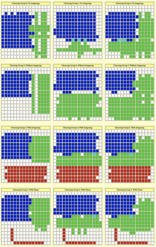
Ho-Seok Ee proposed a new Johab encoding for algorithmic Hangul Syllables generation. The resulting scheme uses 6 variations of initial consonants (choseong), 3 of medial vowels and diphthongs (jungseong), and 1 of final consonants (jongseong). The image on the left is partial output from a new supporting Unifont utility, unijohab2html, which gives an overview of how the three components of a Hangul syllable combine with each other and outputs any overlaps for a font designer's analysis. A full discussion of this new Johab 6/3/1 encoding appears on the Unifont Hangul Syllables Generation web page. Minseo Lee (이민서) provided feedback on the glyphs prior to their release. -
Following a suggestion by Ho-Seok Ee, the
hangul-base.hexfile that contains the Johab 6/3/1 glyphs for Hangul syllable formation now begins at code point U+E000. This allows building a Unifont variant with that entire Hangul johab glyph set in the Uniode Plane 0 Private Use Area (PUA) using the command "make PUA=plane00/hangul/hangul-base.hex". in the font directory. Unifont builds have traditionally left the PUA available for CSUR/UCSUR glyphs, which is still the default; see below for a discussion of the CSUR/UCSUR glyphs. - Johnnie Weaver modified "IJ" ligature glyphs U+0132 and U+0133. He also modified U+1E9E LATIN CAPITAL LETTER SHARP S.
-
Paul Hardy:
- Modified U+2CC2 COPTIC CAPITAL LETTER CROSSED SHEI and U+2CC3 COPTIC SMALL LETTER CROSSED SHEI for consistency with the redrawn U+03E2 COPTIC CAPITAL LETTER SHEI and U+03E3 COPTIC SMALL LETTER SHEI.
- Redrew Ideographic Description Characters (U+2FF0..U+2FFB) for consistency and added new glyphs (U+2FFC..U+2FFF). Also added CJK Strokes glyph U+31EF IDEOGRAPHIC DESCRIPTION CHARACTER SUBTRACTION.
- Modified star glyphs U+2605, U+2606, and U+2BE8 for consistency.
- Modified several Chinese ideographs and Korean ideographs in CJK Unified Ideographs Extension A (U+3400..U+4DBF) per the Unicode Standard version 15.1.0.
- Wen Quan Yi Glyphs: Made modifications to Korean ideographs in CJK Unified Ideographs Extension A (U+3400..U+4DBF) per Unicode 15.1.0 changes. Modified CJK Unified Ideographs Extension A U+3B9D, U+454E, U+49C8 (from 湖 远星) and U+56B8. Modified CJK Unified Ideographs Extension U+809E and U+891D.
- Modified Alchemical Symbols (U+1F700..U+1F77F) per Unicode 15.1.0 changes.
-
Added three hexadecimal digit notations to the Plane 0 UCSUR:
- U+EBE0..U+EBEF: Boby Lapointe's "bibi-binary" notation.
- U+EBF0..U+EBFF: Bruce Alan Martin's bit location notation.
- U+ECF0..U+ECFF: Ronald O. Whitaker's triangular notation.
- Implemented other glyph changes per the Unicode Standard version 15.1.0.
- Several other minor changes; see the ChangeLog file in the main tarball for details.
Earlier Releases
See the Archive link at the top of this page for information on earlier Unifont releases.
Unifont Glyph Tables
Unifont font files contain glyphs in several Unicode planes. The following table provides an overview of this coverage.
| GNU Unifont Font File Plane Coverage | ||||||
|---|---|---|---|---|---|---|
| Font Filename | Plane 0 | Plane 1 | Plane 2 | Plane 3 | Plane 14 | Plane 15 |
unifont-version |
X | X1,2 | X1,2 | |||
unifont_jp-version |
X | X1,2 | X1,2 | |||
unifont_t-version |
X | |||||
unifont_upper-version |
X | X3 | X3 | X | ||
unifont_csur-version |
X | X | ||||
|
Notes: 1PCF fonts can only include glyphs in Plane 0. 2Only a subset of Plane 2 and Plane 3 CJK glyphs plus the Plane 1 Copyleft glyph (U+1F12F) are included, to stay within the OpenType limit of 65,536 glyphs.
3 |
||||||
Click on each link in the tables below to show its corresponding 256-code point range within the respective Unicode planes.
Plane 0 Glyphs
The table below links to the glyphs in the Plane 0 (Basic
Multilingual Plane) unifont font files.
|
GNU Unifont Glyphs
Unicode Basic Multilingual Plane | |||||||||||||||
|---|---|---|---|---|---|---|---|---|---|---|---|---|---|---|---|
| 00 | 01 | 02 | 03 | 04 | 05 | 06 | 07 | 08 | 09 | 0A | 0B | 0C | 0D | 0E | 0F |
| 10 | 11 | 12 | 13 | 14 | 15 | 16 | 17 | 18 | 19 | 1A | 1B | 1C | 1D | 1E | 1F |
| 20 | 21 | 22 | 23 | 24 | 25 | 26 | 27 | 28 | 29 | 2A | 2B | 2C | 2D | 2E | 2F |
| 30 | 31 | 32 | 33 | 34 | 35 | 36 | 37 | 38 | 39 | 3A | 3B | 3C | 3D | 3E | 3F |
| 40 | 41 | 42 | 43 | 44 | 45 | 46 | 47 | 48 | 49 | 4A | 4B | 4C | 4D | 4E | 4F |
| 50 | 51 | 52 | 53 | 54 | 55 | 56 | 57 | 58 | 59 | 5A | 5B | 5C | 5D | 5E | 5F |
| 60 | 61 | 62 | 63 | 64 | 65 | 66 | 67 | 68 | 69 | 6A | 6B | 6C | 6D | 6E | 6F |
| 70 | 71 | 72 | 73 | 74 | 75 | 76 | 77 | 78 | 79 | 7A | 7B | 7C | 7D | 7E | 7F |
| 80 | 81 | 82 | 83 | 84 | 85 | 86 | 87 | 88 | 89 | 8A | 8B | 8C | 8D | 8E | 8F |
| 90 | 91 | 92 | 93 | 94 | 95 | 96 | 97 | 98 | 99 | 9A | 9B | 9C | 9D | 9E | 9F |
| A0 | A1 | A2 | A3 | A4 | A5 | A6 | A7 | A8 | A9 | AA | AB | AC | AD | AE | AF |
| B0 | B1 | B2 | B3 | B4 | B5 | B6 | B7 | B8 | B9 | BA | BB | BC | BD | BE | BF |
| C0 | C1 | C2 | C3 | C4 | C5 | C6 | C7 | C8 | C9 | CA | CB | CC | CD | CE | CF |
| D0 | D1 | D2 | D3 | D4 | D5 | D6 | D7 | Surrogate Pairs | |||||||
| Private Use Area | |||||||||||||||
| Private Use Area | F9 | FA | FB | FC | FD | FE | FF | ||||||||
This next table links to the glyphs in the Plane 0 (Basic
Multilingual Plane) unifont_jp Japanese variant font files.
See also the Plane 2 glyphs further down, which are only
included in the unifont_jp OpenType and TrueType font files.
| GNU Unifont Glyphs — Japanese Version with Page Coverage for Plane 0 (Green=100%, Red=0%) | |||||||||||||||
|---|---|---|---|---|---|---|---|---|---|---|---|---|---|---|---|
| 00 | 01 | 02 | 03 | 04 | 05 | 06 | 07 | 08 | 09 | 0A | 0B | 0C | 0D | 0E | 0F |
| 10 | 11 | 12 | 13 | 14 | 15 | 16 | 17 | 18 | 19 | 1A | 1B | 1C | 1D | 1E | 1F |
| 20 | 21 | 22 | 23 | 24 | 25 | 26 | 27 | 28 | 29 | 2A | 2B | 2C | 2D | 2E | 2F |
| 30 | 31 | 32 | 33 | 34 | 35 | 36 | 37 | 38 | 39 | 3A | 3B | 3C | 3D | 3E | 3F |
| 40 | 41 | 42 | 43 | 44 | 45 | 46 | 47 | 48 | 49 | 4A | 4B | 4C | 4D | 4E | 4F |
| 50 | 51 | 52 | 53 | 54 | 55 | 56 | 57 | 58 | 59 | 5A | 5B | 5C | 5D | 5E | 5F |
| 60 | 61 | 62 | 63 | 64 | 65 | 66 | 67 | 68 | 69 | 6A | 6B | 6C | 6D | 6E | 6F |
| 70 | 71 | 72 | 73 | 74 | 75 | 76 | 77 | 78 | 79 | 7A | 7B | 7C | 7D | 7E | 7F |
| 80 | 81 | 82 | 83 | 84 | 85 | 86 | 87 | 88 | 89 | 8A | 8B | 8C | 8D | 8E | 8F |
| 90 | 91 | 92 | 93 | 94 | 95 | 96 | 97 | 98 | 99 | 9A | 9B | 9C | 9D | 9E | 9F |
| A0 | A1 | A2 | A3 | A4 | A5 | A6 | A7 | A8 | A9 | AA | AB | AC | AD | AE | AF |
| B0 | B1 | B2 | B3 | B4 | B5 | B6 | B7 | B8 | B9 | BA | BB | BC | BD | BE | BF |
| C0 | C1 | C2 | C3 | C4 | C5 | C6 | C7 | C8 | C9 | CA | CB | CC | CD | CE | CF |
| D0 | D1 | D2 | D3 | D4 | D5 | D6 | D7 | Surrogate Pairs | |||||||
| Private Use Area | |||||||||||||||
| Private Use Area | F9 | FA | FB | FC | FD | FE | FF | ||||||||
Unicode T-source Plane 0 glyphs:
| GNU Unifont Glyphs — T-source Version with Page Coverage for Plane 0 (Green=100%, Red=0%) | |||||||||||||||
|---|---|---|---|---|---|---|---|---|---|---|---|---|---|---|---|
| 00 | 01 | 02 | 03 | 04 | 05 | 06 | 07 | 08 | 09 | 0A | 0B | 0C | 0D | 0E | 0F |
| 10 | 11 | 12 | 13 | 14 | 15 | 16 | 17 | 18 | 19 | 1A | 1B | 1C | 1D | 1E | 1F |
| 20 | 21 | 22 | 23 | 24 | 25 | 26 | 27 | 28 | 29 | 2A | 2B | 2C | 2D | 2E | 2F |
| 30 | 31 | 32 | 33 | 34 | 35 | 36 | 37 | 38 | 39 | 3A | 3B | 3C | 3D | 3E | 3F |
| 40 | 41 | 42 | 43 | 44 | 45 | 46 | 47 | 48 | 49 | 4A | 4B | 4C | 4D | 4E | 4F |
| 50 | 51 | 52 | 53 | 54 | 55 | 56 | 57 | 58 | 59 | 5A | 5B | 5C | 5D | 5E | 5F |
| 60 | 61 | 62 | 63 | 64 | 65 | 66 | 67 | 68 | 69 | 6A | 6B | 6C | 6D | 6E | 6F |
| 70 | 71 | 72 | 73 | 74 | 75 | 76 | 77 | 78 | 79 | 7A | 7B | 7C | 7D | 7E | 7F |
| 80 | 81 | 82 | 83 | 84 | 85 | 86 | 87 | 88 | 89 | 8A | 8B | 8C | 8D | 8E | 8F |
| 90 | 91 | 92 | 93 | 94 | 95 | 96 | 97 | 98 | 99 | 9A | 9B | 9C | 9D | 9E | 9F |
| A0 | A1 | A2 | A3 | A4 | A5 | A6 | A7 | A8 | A9 | AA | AB | AC | AD | AE | AF |
| B0 | B1 | B2 | B3 | B4 | B5 | B6 | B7 | B8 | B9 | BA | BB | BC | BD | BE | BF |
| C0 | C1 | C2 | C3 | C4 | C5 | C6 | C7 | C8 | C9 | CA | CB | CC | CD | CE | CF |
| D0 | D1 | D2 | D3 | D4 | D5 | D6 | D7 | Surrogate Pairs | |||||||
| Private Use Area | |||||||||||||||
| Private Use Area | F9 | FA | FB | FC | FD | FE | FF | ||||||||
Plane 1 Glyphs
The next table links to glyphs in Plane 1 (Supplementary
Multilingual Plane) OpenType and TrueType unifont_upper
font files.
Plane 2 Glyphs
This next table links to the Unicode G-source Chinese glyphs in Plane 2
(Supplementary Ideographic Plane) contained in unifont OpenType
and TrueType font files.
Note: These Plane 2 glyphs along with the default Plane 0 glyphs
in Unifont provide complete coverage of the Table of General Standard Chinese
Characters (通用规范汉字表), accounting for 232 glyphs.
Files with no glyphs appear with a gray background.
The following table shows Plane 2 CJK glyph coverage as of Unifont 18.0.01:
| Coverage | Range | Block | Notes |
|---|---|---|---|
| 10.7% | U+20000..U+2A6DF | CJK Unified Ideographs Extension B | Rare, historic |
| 2.5% | U+2A700..U+2B739 | CJK Unified Ideographs Extension C | Rare, historic |
| 100.0% | U+2B740..U+2B81E | CJK Unified Ideographs Extension D | Urgently needed |
| 3.1% | U+2B820..U+2CEA1 | CJK Unified Ideographs Extension E | Rare, historic |
| 0.6% | U+2CEB0..U+2EBE0 | CJK Unified Ideographs Extension F | Rare, historic |
| 100.0% | U+2EBF0..U+2EE5D | CJK Unified Ideographs Extension I | Urgently needed |
| 0.4% | U+2F800..U+2FA1D | CJK Compatibility Ideographs Supplement | Unifiable variants |
The table below links to the Japanese glyphs in Plane 2 (Supplementary Ideographic
Plane) contained in the unifont_jp OpenType and TrueType font files.
Note: These Plane 2 glyphs along with the Plane 0 glyphs in
unifont_jp font files provide complete coverage of the JIS X 0213
standard. Only 303 glyphs appear in the files below. Files with no glyphs appear
with a gray background.
Plane 3 Glyphs
Plane 3 begins with the CJK Unified Ideographs Extension G block, from U+30000 through U+3134A. This includes the highly complex biang Chinese ideograph and taito Japanese ideograph:
- Biang (U+30EDD and U+30EDE)
- Taito (Kanji) (U+3106C).
Files with no glyphs appear with a gray background.
The following table shows Plane 3 CJK glyph coverage as of Unifont 18.0.01:
| Coverage | Range | Block | Notes |
|---|---|---|---|
| 13.0% | U+30000..U+3134A | CJK Unified Ideographs Extension G | Rare, historic |
| 0.5% | U+31350..U+323AF | CJK Unified Ideographs Extension H | Rare, historic |
| 10.4% | U+323B0..U+3347F | CJK Unified Ideographs Extension J | Rare, historic |
Plane 14 Glyphs
This table links to the two ranges of 256 assigned code points
in Plane 14 (Tags and Variation Selector Supplement) that appear
in the unifont_upper OpenType and TrueType font files.
|
GNU Unifont Glyphs
Unicode Plane 14 | |||||||||||||||
|---|---|---|---|---|---|---|---|---|---|---|---|---|---|---|---|
| 0E00 | 0E01 | ||||||||||||||
Plane 0 and Plane 15 Private Use Area Glyphs
Finally, this last glyph table shows ConScript Unicode Registry (CSUR)
and Under CSUR glyphs that appear in the unifont_csur OpenType
and TrueType font files. Not all of the Plane 0 CSUR and UCSUR scripts
have been drawn, but given the esoteric nature of some CSUR and UCSUR scripts
(including the unavailability of glyph samples for many of the more obscure
constructed scripts), the boxes in the table all have a green background color
even if not at 100% coverage.
|
GNU Unifont Glyphs
Private Use Area, Planes 0 and 15 — ConScript Unicode Registry | |||||||||||||||
|---|---|---|---|---|---|---|---|---|---|---|---|---|---|---|---|
| E0 | E1 | E2 | E3 | E4 | E5 | E6 | E7 | E8 | E9 | EA | EB | EC | ED | EE | EF |
| F0 | F1 | F2 | F3 | F4 | F5 | F6 | F7 | F8 | Unicode Assigned Code Points | ||||||
| 0F00 | 0F01 | 0F02 | 0F03 | 0F04 | 0F05 | 0F06 | 0F07 | 0F08 | 0F09 | 0F0A | 0F0B | 0F0C | 0F0D | 0F0E | 0F0F |
| 0F10 | 0F11 | 0F12 | 0F13 | 0F14 | 0F15 | 0F16 | 0F17 | 0F18 | 0F19 | 0F1A | 0F1B | 0F1C | 0F1D | 0F1E | 0F1F |
| 0F20 | 0F21 | 0F22 | 0F23 | 0F24 | 0F25 | 0F26 | 0F27 | 0F28 | 0F29 | 0F2A | 0F2B | 0F2C | 0F2D | 0F2E | 0F2F |
Contributing Glyphs

If you would like to contribute glyphs to the GNU Unifont effort, you can download the associated PNG file from the tables above (SMP and CSUR need additions). Then draw new glyphs in the 16-by-16 pixel area that is inside the inner box you see in the image on the left.
When done, erase the surrounding inner box and ruler lines around the inner box. You can then save the file as a monochrome bitmap image. Then convert the .png file into a .hex file with the unipng2hex utility in the source tarball. Or you can just email the .png file to me as a contribution to this effort and I will do the conversion.
Q: Why is the outer grid so much larger than the 16-by-16 pixel inner box?
A: Because in a future version, unipng2hex, unihex2png, and other utilities should be able to handle larger glyphs.
The table below shows the current state of completion of the Supplementary Multilingual Plane (Plane 1). Any range in the table that doesn't have a green background has missing glyphs. To see which scripts are in a particular range, consult the "Supplementary Multilingual Plane" list in the Current Coverage section below. The more red a range appears in the table below, the more glyphs are missing from that range.
Current Coverage
Links in this section reference the first block of 256 glyphs where a script begins.
The list below shows the scripts that are in the Unicode Basic Multilingual Plane, with coverage in this release of Unifont.
      Covered      Range       Script
        -------      -----       ------
         100.0%  U+0000..U+007F  C0 Controls and Basic Latin
         100.0%  U+0080..U+00FF  C1 Controls and Latin-1 Supplement
         100.0%  U+0100..U+017F  Latin Extended-A
         100.0%  U+0180..U+024F  Latin Extended-B
         100.0%  U+0250..U+02AF  IPA Extensions
         100.0%  U+02B0..U+02FF  Spacing Modifier Letters
         100.0%  U+0300..U+036F  Combining Diacritical Marks
         100.0%  U+0370..U+03FF  Greek and Coptic
         100.0%  U+0400..U+04FF  Cyrillic
         100.0%  U+0500..U+052F  Cyrillic Supplement
         100.0%  U+0530..U+058F  Armenian
         100.0%  U+0590..U+05FF  Hebrew
         100.0%  U+0600..U+06FF  Arabic
         100.0%  U+0700..U+074F  Syriac
         100.0%  U+0750..U+077F  Arabic Supplement
         100.0%  U+0780..U+07BF  Thaana
         100.0%  U+07C0..U+07FF  N'Ko
         100.0%  U+0800..U+083F  Samaritan
         100.0%  U+0840..U+085F  Mandaic
         100.0%  U+0860..U+086F  Syriac Supplement
         100.0%  U+0870..U+089F  Arabic Extended-B
         100.0%  U+08A0..U+08FF  Arabic Extended-A
         100.0%  U+0900..U+097F  Devanagari
         100.0%  U+0980..U+09FF  Bengali
         100.0%  U+0A00..U+0A7F  Gurmukhi
         100.0%  U+0A80..U+0AFF  Gujarati
         100.0%  U+0B00..U+0B7F  Oriya
         100.0%  U+0B80..U+0BFF  Tamil
         100.0%  U+0C00..U+0C7F  Telugu
         100.0%  U+0C80..U+0CFF  Kannada
         100.0%  U+0D00..U+0D7F  Malayalam
         100.0%  U+0D80..U+0DFF  Sinhala
         100.0%  U+0E00..U+0E7F  Thai
         100.0%  U+0E80..U+0EFF  Lao
         100.0%  U+0F00..U+0FFF  Tibetan
         100.0%  U+1000..U+109F  Myanmar
         100.0%  U+10A0..U+10FF  Georgian
         100.0%  U+1100..U+11FF  Hangul Jamo
         100.0%  U+1200..U+137F  Ethiopic
         100.0%  U+1380..U+139F  Ethiopic Supplement
         100.0%  U+13A0..U+13FF  Cherokee
         100.0%  U+1400..U+167F  Unified Canadian Aboriginal Syllabics
         100.0%  U+1680..U+169F  Ogham
         100.0%  U+16A0..U+16FF  Runic
         100.0%  U+1700..U+171F  Tagalog
         100.0%  U+1720..U+173F  Hanunoo
         100.0%  U+1740..U+175F  Buhid
         100.0%  U+1760..U+177F  Tagbanwa
         100.0%  U+1780..U+17FF  Khmer
         100.0%  U+1800..U+18AF  Mongolian
         100.0%  U+18B0..U+18FF  Unified Canadian Aboriginal Syllabics Extended
         100.0%  U+1900..U+194F  Limbu
         100.0%  U+1950..U+197F  Tai Le
         100.0%  U+1980..U+19DF  New Tai Lue
         100.0%  U+19E0..U+19FF  Khmer Symbols
         100.0%  U+1A00..U+1A1F  Buginese
         100.0%  U+1A20..U+1AAF  Tai Tham
         100.0%  U+1AB0..U+1AFF  Combining Diacritical Marks Extended
         100.0%  U+1B00..U+1B7F  Balinese
         100.0%  U+1B80..U+1BBF  Sundanese
         100.0%  U+1BC0..U+1BFF  Batak
         100.0%  U+1C00..U+1C4F  Lepcha
         100.0%  U+1C50..U+1C7F  Ol Chiki
         100.0%  U+1C80..U+1C8F  Cyrillic Extended-C
         100.0%  U+1C90..U+1CBF  Georgian Extended
         100.0%  U+1CC0..U+1CCF  Sundanese Supplement
         100.0%  U+1CD0..U+1CFF  Vedic Extensions
         100.0%  U+1D00..U+1D7F  Phonetic Extensions
         100.0%  U+1D80..U+1DBF  Phonetic Extensions Supplement
         100.0%  U+1DC0..U+1DFF  Combining Diacritical Marks Supplement
         100.0%  U+1E00..U+1EFF  Latin Extended Additional
         100.0%  U+1F00..U+1FFF  Greek Extended
         100.0%  U+2000..U+206F  General Punctuation
         100.0%  U+2070..U+209F  Superscripts and Subscripts
         100.0%  U+20A0..U+20CF  Currency Symbols
         100.0%  U+20D0..U+20FF  Combining Diacritical Marks for Symbols
         100.0%  U+2100..U+214F  Letterlike Symbols
         100.0%  U+2150..U+218F  Number Forms
         100.0%  U+2190..U+21FF  Arrows
         100.0%  U+2200..U+22FF  Mathematical Operators
         100.0%  U+2300..U+23FF  Miscellaneous Technical
         100.0%  U+2400..U+243F  Control Pictures
         100.0%  U+2440..U+245F  Optical Character Recognition
         100.0%  U+2460..U+24FF  Enclosed Alphanumerics
         100.0%  U+2500..U+257F  Box Drawing
         100.0%  U+2580..U+259F  Block Elements
         100.0%  U+25A0..U+25FF  Geometric Shapes
         100.0%  U+2600..U+26FF  Miscellaneous Symbols
         100.0%  U+2700..U+27BF  Dingbats
         100.0%  U+27C0..U+27EF  Miscellaneous Mathematical Symbols-A
         100.0%  U+27F0..U+27FF  Supplemental Arrows-A
         100.0%  U+2800..U+28FF  Braille Patterns
         100.0%  U+2900..U+297F  Supplemental Arrows-B
         100.0%  U+2980..U+29FF  Miscellaneous Mathematical Symbols-B
         100.0%  U+2A00..U+2AFF  Supplemental Mathematical Operators
         100.0%  U+2B00..U+2BFF  Miscellaneous Symbols and Arrows
         100.0%  U+2C00..U+2C5F  Glagolithic
         100.0%  U+2C60..U+2C7F  Latin Extended-C
         100.0%  U+2C80..U+2CFF  Coptic
         100.0%  U+2D00..U+2D2F  Georgian Supplement
         100.0%  U+2D30..U+2D7F  Tifinagh
         100.0%  U+2D80..U+2DDF  Ethiopic Extended
         100.0%  U+2DE0..U+2DFF  Cyrillic Extended-A
         100.0%  U+2E00..U+2E7F  Supplemental Punctuation
         100.0%  U+2E80..U+2EFF  CJK Radicals Supplement
         100.0%  U+2F00..U+2FDF  Kangxi Radicals
         100.0%  U+2FE0..U+2FEF  Unassigned
         100.0%  U+2FF0..U+2FFF  Ideographic Description Characters
         100.0%  U+3000..U+303F  CJK Symbols and Punctuation
         100.0%  U+3040..U+309F  Hiragana
         100.0%  U+30A0..U+30FF  Katakana
         100.0%  U+3100..U+312F  Bopomofo
         100.0%  U+3130..U+318F  Hangul Compatibility Jamo
         100.0%  U+3190..U+319F  Kanbun
         100.0%  U+31A0..U+31BF  Bopomofo Extended
         100.0%  U+31C0..U+31EF  CJK Strokes
         100.0%  U+31F0..U+31FF  Katakana Phonetic Extensions
         100.0%  U+3200..U+32FF  Enclosed CJK Letters and Months
         100.0%  U+3300..U+33FF  CJK Compatibility
         100.0%  U+3400..U+4DBF  CJK Unified Ideographs Extension A
         100.0%  U+4DC0..U+4DFF  Yijing Hexagram Symbols
         100.0%  U+4E00..U+9FFF  CJK Unified Ideographs
         100.0%  U+A000..U+A48F  Yi Syllables
         100.0%  U+A490..U+A4CF  Yi Radicals
         100.0%  U+A4D0..U+A4FF  Lisu
         100.0%  U+A500..U+A63F  Vai
         100.0%  U+A640..U+A69F  Cyrillic Extended-B
         100.0%  U+A6A0..U+A6FF  Bamum
         100.0%  U+A700..U+A71F  Modifier Tone Letters
         100.0%  U+A720..U+A7FF  Latin Extended-D
         100.0%  U+A800..U+A82F  Syloti Nagri
         100.0%  U+A830..U+A83F  Common Indic Number Forms
         100.0%  U+A840..U+A87F  Phags-pa
         100.0%  U+A880..U+A8DF  Saurashtra
         100.0%  U+A8E0..U+A8FF  Devanagari Extended
         100.0%  U+A900..U+A92F  Kayah Li
         100.0%  U+A930..U+A95F  Rejang
         100.0%  U+A960..U+A97F  Hangul Jamo Extended-A
         100.0%  U+A980..U+A9DF  Javanese
         100.0%  U+A9E0..U+A9FF  Myanmar Extended-B
         100.0%  U+AA00..U+AA5F  Cham
         100.0%  U+AA60..U+AA7F  Myanmar Extended-A
         100.0%  U+AA80..U+AADF  Tai Viet
         100.0%  U+AAE0..U+AAFF  Meetei Mayek Extensions
         100.0%  U+AB00..U+AB2F  Ethiopic Extended-A
         100.0%  U+AB30..U+AB6F  Latin Extended-E
         100.0%  U+AB70..U+ABBF  Cherokee Supplement
         100.0%  U+ABC0..U+ABFF  Meetei Mayek
         100.0%  U+AC00..U+D7AF  Hangul Syllables
         100.0%  U+D7B0..U+D7FF  Hangul Jamo Extended-B
           0.0%  U+D800..U+DFFF  Surrogate Pairs - Not Used
           0.0%  U+E000..U+F8FF  Private Use Area - drawn but not included
         100.0%  U+F900..U+FAFF  CJK Compatibility Ideographs
         100.0%  U+FB00..U+FB4F  Alphabetic Presentation Forms
         100.0%  U+FB50..U+FDFF  Arabic Presentation Forms-A
         100.0%  U+FE00..U+FE0F  Variation Selectors
         100.0%  U+FE10..U+FE1F  Vertical Forms
         100.0%  U+FE20..U+FE2F  Combining Half Marks
         100.0%  U+FE30..U+FE4F  CJK Compatibility Forms
         100.0%  U+FE50..U+FE6F  Small Form Variants
         100.0%  U+FE70..U+FEFF  Arabic Presentation Forms-B
         100.0%  U+FF00..U+FFEF  Halfwidth and Fullwidth Forms
         100.0%  U+FFF0..U+FFFF  Specials
The list below shows the scripts that are in the Unicode Supplementary Multilingual Plane, with coverage in this release of Unifont. Scripts labeled "(Pending)" are being drawn currently.
      Covered        Range         Script
        -------        -----         ------
         100.0%  U+010000..U+01007F  Linear B Syllabary
         100.0%  U+010080..U+0100FF  Linear B Ideograms
         100.0%  U+010100..U+01013F  Aegean Numbers
         100.0%  U+010140..U+01018F  Ancient Greek Numbers
         100.0%  U+010190..U+0101CF  Ancient Symbols
         100.0%  U+0101D0..U+0101FF  Phaistos Disc
         100.0%  U+010280..U+01029F  Lycian
         100.0%  U+0102A0..U+0102DF  Carian
         100.0%  U+0102E0..U+0102FF  Coptic Epact Numbers
         100.0%  U+010300..U+01032F  Old Italic
         100.0%  U+010330..U+01034F  Gothic
         100.0%  U+010350..U+01037F  Old Permic
         100.0%  U+010380..U+01039F  Ugaritic
         100.0%  U+0103A0..U+0103DF  Old Persian
         100.0%  U+010400..U+01044F  Deseret
         100.0%  U+010450..U+01047F  Shavian
         100.0%  U+010480..U+0104AF  Osmanya
         100.0%  U+0104B0..U+0104FF  Osage
         100.0%  U+010500..U+01052F  Elbasan
         100.0%  U+010530..U+01056F  Caucasian Albanian
         100.0%  U+010570..U+0105BF  Vithkuqi
         100.0%  U+0105C0..U+0105FF  Todhri
         100.0%  U+010600..U+01077F  Linear A
         100.0%  U+010780..U+0107BF  Latin Extended-F
         100.0%  U+010800..U+01083F  Cypriot Syllabary
         100.0%  U+010840..U+01085F  Imperial Aramaic
         100.0%  U+010860..U+01087F  Palmyrene
         100.0%  U+010880..U+0108AF  Nabataean
         100.0%  U+0108E0..U+0108FF  Hatran
         100.0%  U+010900..U+01091F  Phoenecian
         100.0%  U+010920..U+01093F  Lydian
         100.0%  U+010940..U+01095F  Sidetic
         100.0%  U+010980..U+01099F  Meroitic Hieroglyphs
         100.0%  U+0109A0..U+0109FF  Meroitic Cursive
         100.0%  U+010A00..U+010A5F  Kharoshthi
         100.0%  U+010A60..U+010A7F  Old South Arabian
         100.0%  U+010A80..U+010A9F  Old North Arabian
         100.0%  U+010AC0..U+010AFF  Manichaean
         100.0%  U+010B00..U+010B3F  Avestan
         100.0%  U+010B40..U+010B5F  Inscriptional Parthian
         100.0%  U+010B60..U+010B7F  Inscriptional Pahlavi
         100.0%  U+010B80..U+010BAF  Psalter Pahlavi
         100.0%  U+010C00..U+010C4F  Old Turkic
         100.0%  U+010C80..U+010CFF  Old Hungarian
         100.0%  U+010D00..U+010D3F  Hanifi Rohingya
         100.0%  U+010D40..U+010D8F  Garay
         100.0%  U+010E60..U+010E7F  Rumi Numeral Symbols
         100.0%  U+010E80..U+010EBF  Yezidi
         100.0%  U+010EC0..U+010EFF  Arabic Extended-C
         100.0%  U+010F00..U+010F2F  Old Sogdian
         100.0%  U+010F30..U+010F6F  Sogdian
         100.0%  U+010F70..U+010FAF  Old Uyghur
         100.0%  U+010FB0..U+010FDF  Chorasmian
         100.0%  U+010FE0..U+010FFF  Elymaic
         100.0%  U+011000..U+01107F  Brahmi
         100.0%  U+011080..U+0110CF  Kaithi
         100.0%  U+0110D0..U+0110FF  Sora Sompeng
         100.0%  U+011100..U+01114F  Chakma
         100.0%  U+011150..U+01117F  Mahajani
         100.0%  U+011180..U+0111DF  Sharada
         100.0%  U+0111E0..U+0111FF  Sinhala Archaic Numbers
         100.0%  U+011200..U+01124F  Khojki
         100.0%  U+011280..U+0112AF  Multani
         100.0%  U+0112B0..U+0112FF  Khudawadi
         100.0%  U+011300..U+01137F  Grantha
         100.0%  U+011380..U+0113FF  Tulu-Tigalari
         100.0%  U+011400..U+01147F  Newa
         100.0%  U+011480..U+0114DF  Tirhuta
         100.0%  U+011580..U+0115FF  Siddham
         100.0%  U+011600..U+01165F  Modi
         100.0%  U+011660..U+01167F  Mongolian Supplement
         100.0%  U+011680..U+0116CF  Takri
         100.0%  U+0116D0..U+0116FF  Myanmar Extended-C
         100.0%  U+011700..U+01174F  Ahom
         100.0%  U+011800..U+01184F  Dogra
         100.0%  U+0118A0..U+0118FF  Warang Citi
         100.0%  U+011900..U+01195F  Dives Akuru
         100.0%  U+0119A0..U+0119FF  Nandinagari
         100.0%  U+011A00..U+011A4F  Zanabazar Square
         100.0%  U+011A50..U+011AAF  Soyombo
         100.0%  U+011AB0..U+011ABF  Unified Canadian Aboriginal Syllabics Extended-A
         100.0%  U+011AC0..U+011AFF  Pau Cin Hau
         100.0%  U+011B00..U+011B5F  Devanagari Extended-A
         100.0%  U+011B60..U+011B7F  Sharada Supplement
         100.0%  U+011BC0..U+011BFF  Sunuwar
         100.0%  U+011C00..U+011C6F  Bhaiksuki
         100.0%  U+011C70..U+011CBF  Marchen
         100.0%  U+011D00..U+011D5F  Masaram Gondi
         100.0%  U+011D60..U+011DAF  Gunjala Gondi
         100.0%  U+011DB0..U+011DEF  Tolong Siki
         100.0%  U+011DF0..U+011DFF  Bengali Supplement
         100.0%  U+011EE0..U+011EFF  Makasar
         100.0%  U+011F00..U+011F5F  Kawi
         100.0%  U+011FC0..U+011FFF  Tamil Supplement
           0.0%  U+012000..U+0123FF  Cuneiform*
           0.0%  U+012400..U+01247F  Cuneiform Numbers and Punctuation*
           0.0%  U+012480..U+01254F  Early Dynastic Cuneiform*
           0.0%  U+012550..U+01268F  Archaic Cuneiform Numerals
         100.0%  U+012F90..U+012FFF  Cypro-Minoan
           0.0%  U+013000..U+01342F  Egyptian Hieroglyphs*
         100.0%  U+013430..U+01345F  Egyptian Hieroglyph Format Controls
           0.0%  U+013460..U+0143FF  Egyptian Hieroglyphics Extended-A
           0.0%  U+014400..U+01467F  Anatolian Hieroglyphs*
         100.0%  U+016100..U+01613F  Gurung Khema
           0.0%  U+016800..U+016A3F  Bamum Supplement (In Progress)
         100.0%  U+016A40..U+016A6F  Mro
         100.0%  U+016A70..U+016ACF  Tangsa
         100.0%  U+016AD0..U+016AFF  Bassa Vah
         100.0%  U+016D40..U+016D7F  Kirat Rai
         100.0%  U+016B00..U+016B8F  Pahawh Hmong
         100.0%  U+016E40..U+016E9F  Medefaidrin
         100.0%  U+016EA0..U+016EDF  Beria Erfe
         100.0%  U+016F00..U+016F9F  Miao
         100.0%  U+016FE0..U+016FFF  Ideographic Symbols and Punctuation
           0.0%  U+017000..U+0187FF  Tangut
           0.0%  U+018800..U+018AFF  Tangut Components
         100.0%  U+018B00..U+018CFF  Khitan Small Script
           0.0%  U+018D00..U+018D7F  Tangut Supplement
           0.0%  U+018D80..U+018DFF  Tangut Components Supplement
           0.0%  U+018E00..U+019191  Jurchen
           0.0%  U+0191A0..U+0191DF  Jurchen Radicals
         100.0%  U+01AFF0..U+01AFFF  Kana Extended-B
         100.0%  U+01B000..U+01B0FF  Kana Supplement
         100.0%  U+01B100..U+01B12F  Kana Extended-A
         100.0%  U+01B130..U+01B16F  Small Kana Extension
         100.0%  U+01B170..U+01B2FF  Nushu
         100.0%  U+01BC00..U+01BC9F  Duployan
         100.0%  U+01BCA0..U+01BCAF  Shorthand Format Controls
         100.0%  U+01CC00..U+01CEBF  Symbols for Legacy Computing
         100.0%  U+01CEC0..U+01CEFF  Miscellaneous Symbols Supplement
         100.0%  U+01CF00..U+01CFCF  Znamenny Musical Notation
         100.0%  U+01D000..U+01D0FF  Byzantine Musical Symbols
         100.0%  U+01D100..U+01D1FF  Musical Symbols
         100.0%  U+01D200..U+01D24F  Ancient Greek Musical Notation
         100.0%  U+01D250..U+01D28F  Musical Symbols Supplement
         100.0%  U+01D2E0..U+01D2FF  Mayan Numerals
         100.0%  U+01D300..U+01D35F  Tai Xuan Jing Symbols
         100.0%  U+01D360..U+01D37F  Counting Rod Numerals
         100.0%  U+01D400..U+01D7FF  Mathematical Alphanumeric Symbols
         100.0%  U+01D800..U+01DAAF  Sutton SignWriting
         100.0%  U+01DB00..U+01DBFF  Miscellaneous Symbols and Arrows Extended
         100.0%  U+01DF00..U+01DFFF  Latin Extended-G
         100.0%  U+01E000..U+01E02F  Glagolitic Supplement
         100.0%  U+01E100..U+01E14F  Nyiakeng Puachue Hmong
         100.0%  U+01E290..U+01E2BF  Toto
         100.0%  U+01E2C0..U+01E2FF  Wancho
         100.0%  U+01E5D0..U+01E5FF  Ol Onal
         100.0%  U+01E6C0..U+01E6FF  Tai Yo
         100.0%  U+01E7E0..U+01E7FF  Ethiopic Extended-B
         100.0%  U+01E800..U+01E8DF  Mende Kikakui
         100.0%  U+01E900..U+01E95F  Adlam
         100.0%  U+01EC70..U+01ECBF  Indic Siyaq Numbers
         100.0%  U+01ED00..U+01ED4F  Ottoman Siyaq Numbers
         100.0%  U+01EE00..U+01EEFF  Arabic Mathematical Alphabetic Symbols
         100.0%  U+01F000..U+01F02F  Mahjong Tiles
         100.0%  U+01F030..U+01F09F  Domino Tiles
         100.0%  U+01F0A0..U+01F0FF  Playing Cards
         100.0%  U+01F100..U+01F1FF  Enclosed Alphanumeric Supplement
         100.0%  U+01F200..U+01F2FF  Enclosed Ideographic Supplement
         100.0%  U+01F300..U+01F5FF  Miscellaneous Symbols and Pictographs
         100.0%  U+01F600..U+01F64F  Emoticons
         100.0%  U+01F650..U+01F67F  Ornamental Dingbats
         100.0%  U+01F680..U+01F6FF  Transport and Map Symbols
         100.0%  U+01F700..U+01F77F  Alchemical Symbols
         100.0%  U+01F780..U+01F7FF  Geometric Shapes Extended
         100.0%  U+01F800..U+01F8FF  Supplemental Arrows-C
         100.0%  U+01F900..U+01F9FF  Supplemental Symbols and Pictographs
         100.0%  U+01FA00..U+01FA6F  Chess Symbols
         100.0%  U+01FA70..U+01FAFF  Symbols and Pictographs Extended-A
         100.0%  U+01FB00..U+01FBFF  Symbols for Legacy Computing
*Note: Scripts such as Egyptian Hieroglyphs will not be drawn on a 16-by-16 pixel grid. There are plans to draw these scripts on a 32-by-32 pixel grid in the future.
Plane 14 has two scripts, both of which Unifont covers:
|
GNU Unifont Glyphs
Plane 14 |
|||||||||||||||
|---|---|---|---|---|---|---|---|---|---|---|---|---|---|---|---|
| Range | Script | ||||||||||||||
| U+0E0000..U+0E007F | Tags | ||||||||||||||
| U+0E0100..U+0E01EF | Variations Selectors Supplement | ||||||||||||||
The list below shows the scripts that are in Michael Everson's ConScript Unicode Registry (CSUR) and Rebecca Bettencourt's Under-CSUR that have coverage in this release of Unifont:
Initially I just posted my additions to Roman Czyborra's original unifont.hex file. Then in mid-January 2008, his website went down. So I started posting font updates here. Roman has encouraged me to continue with my additions.
Roman's website is now back online, and you can read his Unifont description and motivation for its creation on his website, along with his archive of Unifont's changes: http://czyborra.com/unifont.
TrueType Font Generation
Luis Alejandro González Miranda wrote a cool combination of scripts to convert GNU Unifont from .hex format into FontForge .sfd format, then to have FontForge convert this to a TrueType outline font (see the Unicode Utilities web page on this site for more information). Pixels are drawn as outlined squares, so they scale to all point sizes. This works well with GNOME; I haven't tried it with any other Unix windowing environment. I've removed the OpenType SBIT font link from this page because the outline font is much more flexible.
Luis has given me permission to modify his scripts to convert the latest GNU Unifont versions to TrueType. I've modified his original scripts to handle Unicode combining characters.
JIS X 0213 Kanji
Jiskan16
Unifont 12.1.02 added Japanese BDF and TrueType versions,
unifont_jp. This replaced over 10,000 ideographs
in the default Unifont font with Japanese kanji from the 16 × 16
pixel Jiskan 16 font. The font is available in two files,
corresponding to the two planes in JIS X 0213. Both files are
in the public domain.
The comments in the BDF source font files (downloadable from the Japanese Fonts page) credit the following contributors (in order): Toshiyuki Imamura, HANATAKA Shinya, Taichi Kawabata, Koichi Yasuoka, TOYOSHIMA Masayuki, Kazuo Koike, and SATO Yasunao.
For the Unifont release, the glyphs from the two JIS X 0213 planes were converted into Unifont .hex files and mapped to code points in Unicode's Plane 0 and Plane 2 for Unifont. The result provides complete representation of the kanji in JIS X 0213 in a free Unicode font.
Izumi16
Unifont 12.1.03 replaced the Jiskan16 glyphs with the public domain Izumi16 glyphs. These provide improvements on the earlier Jiskan16 glyphs.
Wen Quan Yi: Spring of Letters (文泉驛 / 文泉驿)
The original Unifont CJK glyphs were replaced by new CJK glyphs from version 1.1 of Qianqian Fang's Unibit font. The Unibit font began as a combination of the original GNU Unifont glyphs and a basic CJK bitmap font placed in the public domain by the People's Republic of China. It adopted GNU Unifont's scheme of 8x16 and 16x16 glyphs. Qianqian Fang and many others then added about 10,000 more glyphs.
Qianqian states in the Unibit distribution: "The entire CJK Unified Ideographics (U4E00-U9FA5) and CJK Unified Ideographics Extension A(U3400-U4DB5) blocks were replaced by high-quality glyphs from China National Standard GB19966-2005 (public domain)." Wen Quan Yi volunteeers then edited thousands of these characters. Qianqian also drew the new 22 CJK ideographs in the range U+9FA6..U+9FBB that appear in GNU Unifont.
Wen Quan Yi (WQY) means "spring of letters," as in a spring of water. This is an interesting choice of words, as the British spelling of "font" is "fount" (but still pronounced "font"). See his website for more details: http://wqy.sourceforge.net/cgi-bin/enindex.cgi, or in Chinese at http://wenq.org/wqy2/index.cgi.
The following code points in the latest unifont.hex file are taken from the WQY Unibit font (with my additions to complete the U+3000..U+33FF range, particularly the missing Hiragana, Katakana, and Kanji), including glyphs updated by the Wen Quan Yi volunteers and other modifications as part of the Unifont font:
- U+2E80..U+2EFF: CJK Radicals Supplement
- U+2F00..U+2FDF: Kangxi Radicals
- U+2FF0..U+2FFF: Ideographic Description Characters
- U+3000..U+303F: CJK Symbols and Punctuation
- U+31C0..U+31EF: CJK Strokes
- U+3200..U+32FF: Enclosed CJK Letters and Months
- U+3300..U+33FF: CJK Compatibility
- U+3400..U+4DBF: CJK Unified Ideographs Extension A
- U+4E00..U+9FBF: CJK Unified Ideographs
- U+F900..U+FAFF: CJK Compatibility Ideographs
- U+FF00..U+FF60: Fullwidth Forms of Roman Letters
Qianqian has given his okay to add these CJK glyphs from the Wen Quan Yi project into GNU Unifont. Likewise, I've told him to incorporate any glyphs he wants from my contributions to GNU Unifont into his Unibit font. In October 2020, Qianqian Fang also granted permission to apply the SIL Open Font License version 1.1 to Wen Quan Yi glyphs in Unifont as a dual license.
What's Next?
All of the glyphs in the Supplementary Multilingual Plane that could easily be drawn in a 16-by-16 pixel grid have been drawn as of the Unifont 9.0.01 release. A number of ConScript Unicode Registry (CSUR) scripts remain to be drawn. If you are interested in contributing glyphs to this effort, please contact me. All new contributions must be licensed under the same license as the rest of Unifont (in a nutshell, GPL 2+ with the GNU font embedding exception and the SIL OFL 1.1).
With the great work done by contributors in providing ConScript Unicode Registry (CSUR) glyphs, they are available in font files that have "_csur" in their name.


